
Restaurant Competitive Pricing

Compare restaurant prices against competitors before a price move reaches the menu.

MenuInformatics helps pricing, finance, operations, franchise, marketing, and restaurant leadership teams compare competitor prices, item ladders, bundles, modifiers, offers, channels, and local movement before deciding which competitive-pricing actions deserve a governed subscription setup.

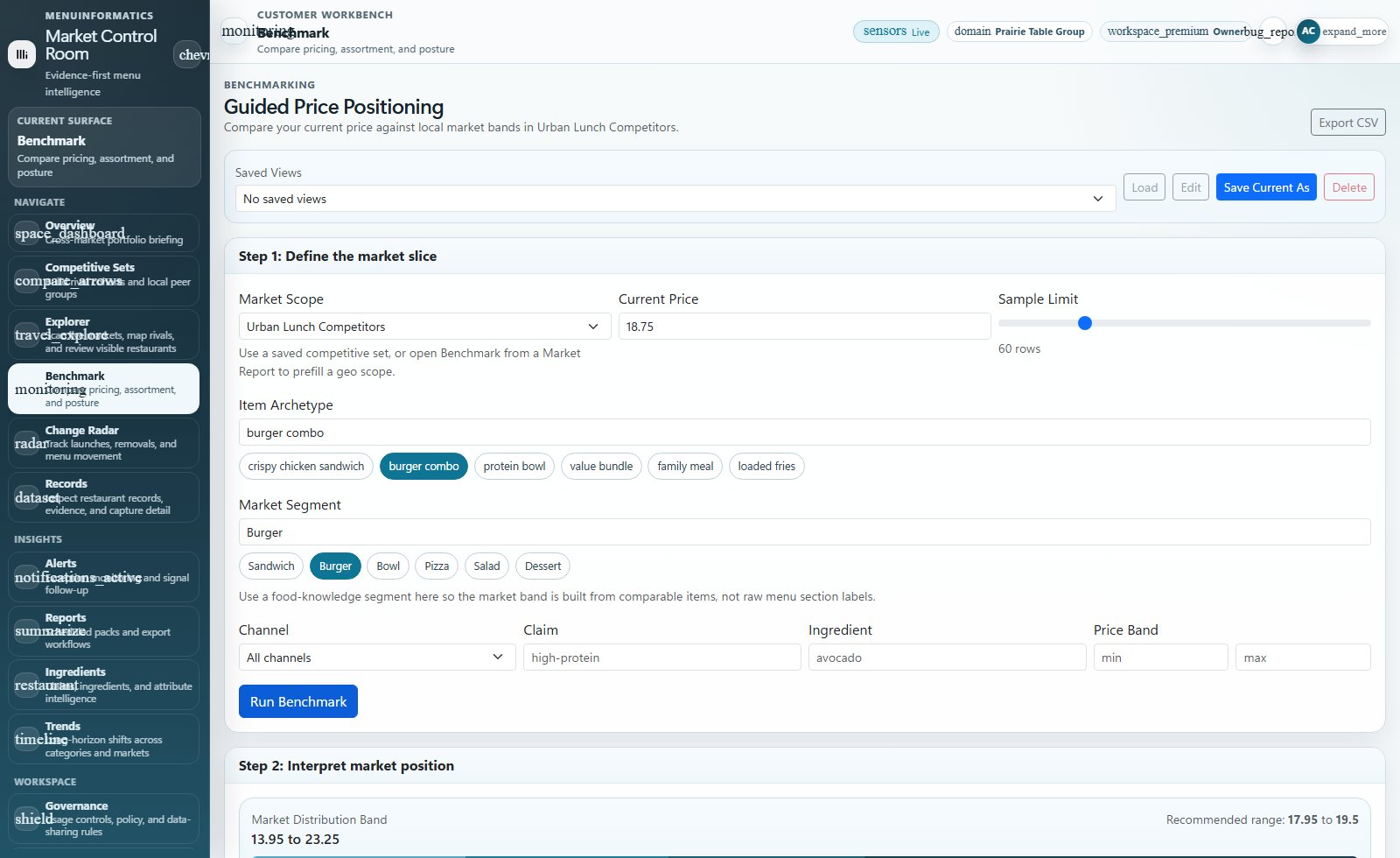
MenuInformatics restaurant competitive pricing workflow
Competitive Pricing Review Path

Competitive pricing needs price position, offer context, and internal economics kept separate.

The first review should show which public competitor signals support a price-position finding, which buyer-owned inputs are required, and how the decision moves into monitoring.

Buyer question: Which competitor price gaps need defensible market evidence before your team changes items, offers, bundles, modifiers, fees, or channels?
Competitive pricing outcome: A scoped price-position review with evidence boundaries, competitor sets, offer context, owners, monitoring cadence, and subscription handoff attached.
Competitive Pricing Scope

Start competitive pricing with the decision, market, and competitor set clearly named.

Restaurant competitive pricing should define the owned locations, target markets, channels, priority categories, competitor group, and buyer-owned constraints before teams debate any price move.

  • Owned locations, trade areas, channels, priority categories, decision owners, and competitor sets named before the first price comparison.
  • Public menu, price, offer, modifier, fee, source, and observed-date evidence separated from buyer-owned sales, margin, cost, traffic, and franchise inputs.
  • Competitive-pricing scope connected to pricing intelligence, benchmarking, price optimization, menu pricing strategy, price monitoring, or report delivery before kickoff.
Price Position Review

Show where items sit against competitor price bands before approving a change.

MenuInformatics helps buyers compare visible list prices, size ladders, modifiers, bundles, delivery variants, and nearby competitor movement before price position is summarized.

  • Anchor items, entry prices, premium ladders, combos, family meals, add-ons, modifiers, fees, and channel variants grouped into comparable review sets.
  • Competitor price positions tagged by evidence source, observed date, geography, channel, freshness caveat, and comparability note.
  • Output prepared for pricing intelligence, restaurant benchmarking, price data, price optimization, executive reporting, or API handoff.
Offer And Channel Context

Read competitive pricing beside offers, bundles, modifiers, fees, and delivery channels.

A competitive price can look wrong when the offer, bundle, modifier, or channel context is missing, so the first review keeps the surrounding menu evidence visible.

  • Delivery, pickup, dine-in, marketplace, franchise, regional, bundle, promo, modifier, and fee differences reviewed before price gaps are generalized.
  • Buyer-owned economics, operations limits, brand guardrails, franchise rules, and margin assumptions documented as inputs rather than inferred from public menus.
  • Candidate follow-up routed into price monitoring, promotion data, menu strategy, revenue management, or competitive-intelligence reporting paths.
Monitoring And Handoff

Turn competitive-pricing interest into a monitored workflow with owners and proof attached.

The first competitive-pricing subscription setup should define proof, owners, review cadence, source retention, caveat handling, reporting needs, and the first-touch follow-up path.

  • Pricing, finance, analytics, marketing, franchise, operations, procurement, and executive owners named before rollout.
  • Monitoring cadence, source retention, exports, report delivery, API needs, support handoff, and caveat handling reviewed together.
  • MICT first-touch plan, proof path, opening question, follow-up owner, and next action prepared from the subscription signup.
Competitive Pricing Outcomes

Use the first competitive-pricing review to decide price position, caveats, and monitoring paths.

Position
Compare owned menu prices against competitor bands, item ladders, channels, offers, and local market movement.
Context
Keep bundles, modifiers, fees, promotions, delivery variants, and buyer-owned economics visible before recommendations are ranked.
Monitoring
Convert price-position interest into recurring monitoring, reports, exports, API delivery, and accountable follow-up.