
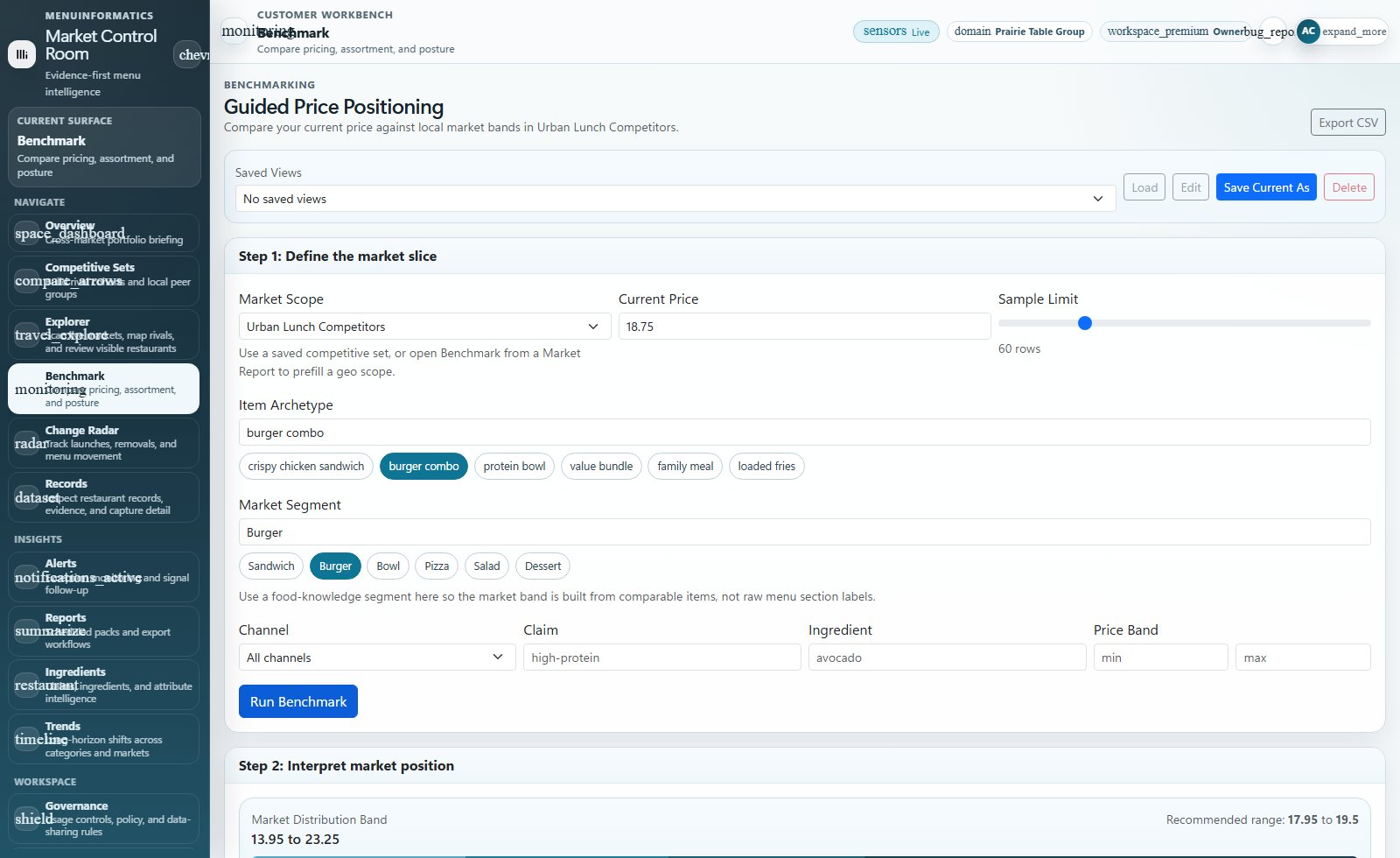
Restaurant Benchmarking

Scope restaurant benchmarking before price, menu, or market decisions depend on it.

MenuInformatics helps operators, pricing teams, franchise teams, and restaurant brands turn public restaurant evidence into comparable menu and price benchmarks, local movement review, reporting governance, and subscription handoff.

MenuInformatics restaurant benchmarking workflow
Benchmark Review

Restaurant benchmarking works when comparable sets, source evidence, and follow-up decisions stay connected.

Buyers evaluating restaurant benchmarking need more than a table of prices. They need the comparable-set logic, evidence quality, movement history, report format, and owner handoff that makes the benchmark defensible.

Buyer question: Which benchmark decision should the first subscription setup make easier to defend?
Benchmarking outcome: A subscription review with comparable sets, menu and price evidence, market movement, governance, and delivery path attached.
Benchmark Scope Design

Define the markets, competitors, categories, and decisions before benchmarking becomes a spreadsheet project.

Restaurant benchmarking is useful only when every stakeholder agrees which restaurants, menus, categories, items, markets, and time windows are comparable.

  • Target markets, brands, local competitors, owned locations, and excluded comparables named before the first review.
  • Benchmark questions separated for price, menu structure, offer pressure, franchise review, reporting, and API handoff.
  • Source caveats, stale evidence, missing prices, category aliases, and duplicate items surfaced before benchmark numbers circulate.
Comparable Menu And Price Sets

Compare menu items, categories, modifiers, price bands, and offers against defensible local comparables.

Operators need benchmark rows they can explain: why an item is comparable, where it came from, when it moved, and what local context changes the interpretation.

  • Item, category, size, modifier, combo, bundle, claim, and channel differences reviewed before comparing prices.
  • Comparable-set logic tied to nearby restaurants, chain rollups, franchise territories, and market reports.
  • Benchmark output prepared for workspace review, executive report, dataset, export, or API delivery.
Local Market Movement

Turn benchmark snapshots into movement review when competitors change price, menu, or offer position.

Static benchmarking falls stale fast. Buyers need a path from baseline comparison into movement tracking, alerts, reports, and decisions.

  • Movement signals grouped for menu launches, removals, price changes, promotion changes, and category pressure.
  • Competitive-set, market-intelligence, price-monitoring, and change-radar paths aligned before recurring review.
  • Review cadence names who receives benchmark movement, which deltas deserve follow-up, and how source evidence is retained.
Benchmark Governance

Make benchmarking repeatable through evidence, ownership, reporting cadence, and customer-success handoff.

Benchmarking becomes operational when the subscription setup has a named owner, source rules, confidence boundaries, delivery format, and escalation path.

  • Report, workspace, export, API, evidence retention, taxonomy, and access expectations set before rollout.
  • Data-quality, source-evidence, and freshness caveats routed into the subscription setup instead of hidden in benchmark tables.
  • MICT first-touch proof path, follow-up owner, and next action prepared from the subscription signup.
Benchmarking Outcomes

Restaurant benchmarking should connect comparable sets, market movement, and governed delivery.

Comparable Sets
Restaurant, menu, item, category, and market comparables stay attached to the benchmark instead of living in disconnected sheets.
Movement Review
Benchmark baselines can turn into price, menu, offer, and competitor movement review without changing workflows.
Governed Handoff
The same scoped benchmark can feed workspaces, reports, exports, APIs, and operator follow-up with source evidence visible.